by learnformula
Explore courses
search
For Business
Team license & compliance management
For Higher Education
Academic partnerships
For Government Agencies
Government training solutions
For Instructors & Course Creators
Teach on our marketplace
Become a Sponsor
Reach professionals where they learn
Log inStart 7-Day Free TrialStart Free TrialStart Free Trial
search
Explore courses
  1. Courses
  2. /Engineering
  3. /General Construction

Connecting Precast/Tilt-up to meet High In-plane Shear Load

How to Connect Individual Precast or Tilt-up Shear Walls to Resist High In-plane Shear Load Demands
Created byMukarim Syed
BeginnerUpdated Feb 8, 2023
Connecting Precast/Tilt-up to meet High In-plane Shear Load

About This Course

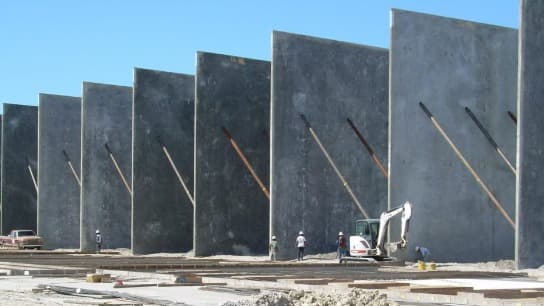
Often working with concrete (Tilt-up or precast) wall panels, contract drawings require large in-plane shear loads, due to earthquake or wind, to be resisted by these walls. It is also not uncommon to see additional requirements of zero or no uplift on supporting foundations. However, the specified magnitude typically exceeds what a single wall panel can resist on its own, including additional dead loads besides self-weight.

Therefore, individual Walls need to be rigidly connected ('stitched') at their edges to act as a longer wail to resist specified lateral load wiTtir project specifications. This course presents an approach to analysis and design where multiple concrete wall panels are interconnected at edges to resist lateral loads. The course material is presented with the aid of a worked example. The example uses US-customary units however, SI equivalents are also included, where feasible to aid students more familiar with the SI system of units.

Course Content

2 activities • 1 chapters • duration: 1 hour

  • descriptionStudy Guide.pdf

Your Instructor

Mukarim Syed

Structural Engineer

menu_book1 courses
star7 reviews

I’m a structural engineer with 25 years of experience designing concrete, steel, masonry, and wood structures. I am well experienced in design of precast concrete, prestressed or conventionally reinforced, structures. I hold a Master’s degree in Structural Engineering and Construction, and am licensed in multiple US states as Professional Engineer.

Credit Information

What Students Are Saying

4.6 out of 5
Student's Choice
7 reviews

Frequently Asked Questions

We are a registered provider with 300+ associations and regulatory bodies worldwide. We operate across 27 global markets including Canada, the US, Australia, and the UK. Every course page clearly displays its specific accreditations. Upon completion, you receive a professional certificate that can be validated online. Our certificates include all necessary accreditation details, credit hours, and completion dates, and are formatted specifically to meet the submission requirements of most global regulatory bodies.

You May Also Like

  • Engineering: Technology & Science

    Claude for Workflow Automation in Engineering

    starRated4.8out of 5,(39 reviews)
    1 CPD hr
  • Engineering: Structural Engineering

    Structural Forensic Engineering of Buildings

    starRated5.0out of 5,(28 reviews)
    7 CPD hrs
  • Engineering: Mechanical Engineering

    Pneumatic Fundamentals: Concepts to Circuits

    starRated5.0out of 5,(26 reviews)
    3 CPD hrs