
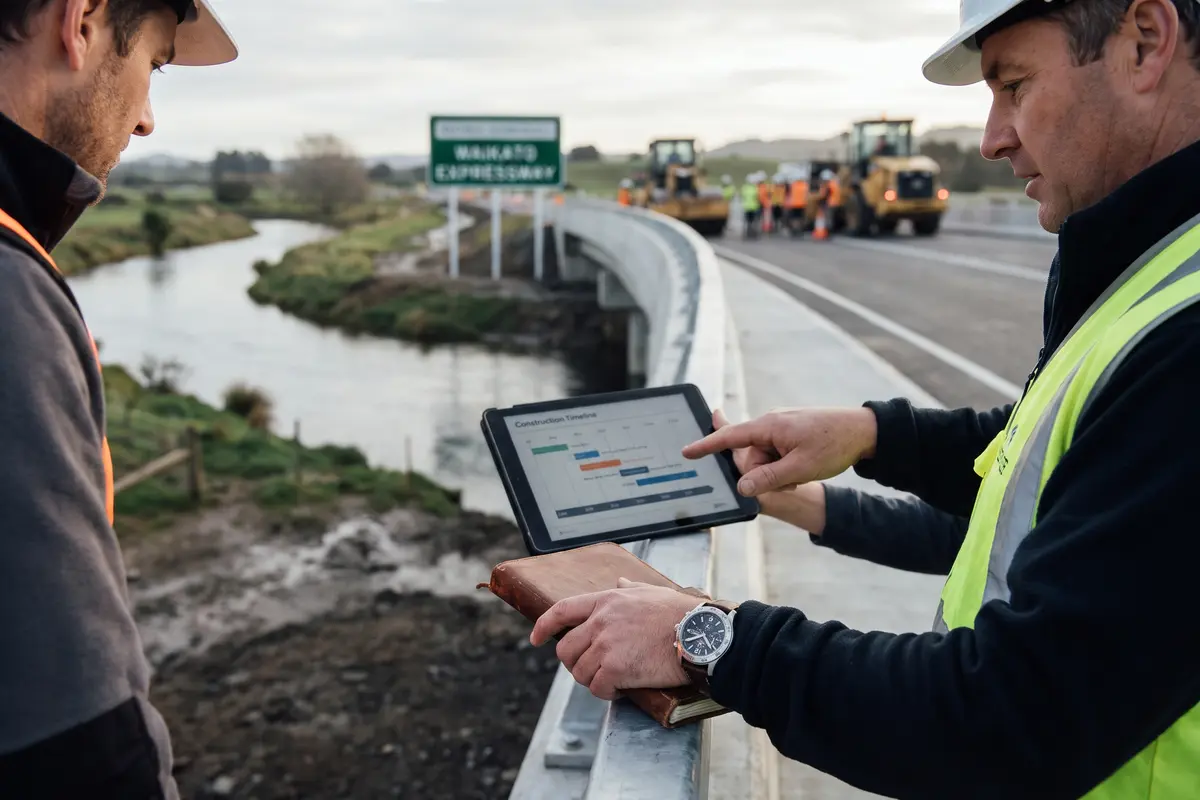

Two weeks early is the kind of result that rarely makes headlines in civil engineering, yet it carries a lot of information. When the NZ Transport Agency Waka Kotahi reopened a critical bridge link in the Waikato district ahead of its forecast date, the milestone was a signal about how well a complex piece of transport infrastructure was planned, sequenced and delivered. For engineers working on New Zealand's road network, the more useful question is not simply that it finished early, but why it could.
What Happened in the Waikato
According to the primary report on the reopening, the agency completed critical bridge infrastructure works in the Waikato district, restoring key transport connections two weeks earlier than forecast. The announcement is brief, but it points to a project that met its technical objectives while outpacing its own timetable.
Early completions of this kind are uncommon enough to deserve closer study. Most transport projects in New Zealand are judged against their original programmes, and programme slippage tends to attract more scrutiny than acceleration. Understanding what allowed this result to land ahead of time is therefore valuable to anyone planning similar works.
Critical bridge works were completed and key transport connections reopened two weeks ahead of forecast. (Summary of the NZTA announcement)
The Corridor Context: SH1 Between Cambridge and Piarere
The Waikato reopening does not sit in isolation. NZTA's project page for SH1 Cambridge to Piarere describes next-phase construction and safety engineering work across the corridor, including scheduled night works. Taken together, the two pieces of information show a state highway network being upgraded in stages while traffic continues to flow.
That reality shapes how engineers approach delivery. On a live corridor, every closure is a negotiation between construction efficiency, freight reliability, emergency access and public tolerance. Night works are often the mechanism that makes this negotiation workable, allowing heavy lifting, pavement work and structural tie-ins to happen when traffic volumes are lowest.
The practical implications are clear:
- Staging matters as much as method. Sequencing works so that each phase leaves the corridor in a safe, predictable state is often what protects the programme.
- Night works carry hidden risk. Reduced visibility, fatigue, lighting constraints and restricted access all increase the importance of rigorous temporary traffic management design.
- Safety engineering is a delivery input, not an afterthought. The NZTA project description explicitly pairs construction with safety engineering, reflecting a shift toward designing risk out of the work zone from the outset.
Why Early Completion Is Harder Than It Looks
Finishing ahead of schedule on a bridge project depends on factors that often remain invisible to the public. Ground conditions may prove more favourable than investigated. Fabrication may arrive on time or early. Weather windows may open more often than the programme assumed. But the most reliable accelerators are usually organisational: clear decision rights, early engagement with utilities and stakeholders, and a willingness to adjust sequencing when conditions change.
It is worth being cautious here. The available summary does not detail the specific contributing factors behind the two-week gain, and engineers should avoid assuming that a single approach can be copied wholesale. What can be drawn out is a set of recurring conditions that tend to support schedule confidence.
Conditions That Support Schedule Confidence
- Realistic baseline forecasting: A forecast that is credible from the start leaves room for genuine improvement rather than recovery from optimistic assumptions.
- Integrated traffic management: Temporary traffic management planned alongside the works, not after them, reduces rework and stop-start delays.
- Early identification of critical path activities: Knowing which tasks govern completion allows resources to be focused where they change the outcome.
- Continuous stakeholder communication: Freight operators, local councils and communities who understand closure windows are less likely to generate disruption-driven delays.
- Disciplined safety integration: Works that are safe by design tend to avoid the stoppages that follow incidents or regulatory intervention.
A Signal from the Energy Sector
A separate development points to a broader shift in how engineering disciplines define their remit. The Electricity Engineers' Association's move to become the Electricity Industry Association was framed as a response to the energy transition and a broadening of industry scope. The rebrand reflects an acknowledgement that engineering challenges no longer sit neatly within single professional silos.
For transport and infrastructure engineers, the parallel is instructive. Bridges, corridors, power networks and communications assets increasingly interact. A road closure can affect substation access. A new transmission route can influence where road reserves are needed. Engineers who understand adjacent systems are better placed to anticipate these interfaces before they become programme risks.
Comparing Delivery Approaches on Live Corridors
The table below sets out how different delivery approaches tend to affect outcomes on live transport corridors. It is a general comparison intended to support planning discussions rather than a description of any specific NZTA contract.
| Approach | Typical Programme Impact | Traffic Disruption | Key Engineering Consideration |
|---|---|---|---|
| Full daytime closure | Shorter duration, fewer work windows | High, concentrated | Detour capacity and emergency access |
| Scheduled night works | Longer duration, more windows | Lower daytime impact, higher night risk | Lighting, fatigue, traffic management design |
| Staged lane closures | Moderate duration, continuous access | Moderate, spread across corridor | Lane width, merge sequencing, queue management |
| Accelerated bridge construction | Reduced on-site time | Concentrated but brief | Prefabrication logistics, connection tolerances |
Practical Implications for Engineering Professionals
Several lessons emerge for engineers working in New Zealand's infrastructure sector:
- Treat forecast dates as hypotheses to test. Early and late completions both reveal something about planning assumptions.
- Document what drove the result. Lessons on sequencing, procurement and stakeholder management are only valuable if they are captured and shared.
- Design traffic management as an engineering discipline. Its quality directly affects safety, productivity and public confidence.
- Plan for interfaces across asset classes. Transport, energy and communications networks increasingly depend on one another.
- Build night-works competence deliberately. Supervisors, planners and crews need training and clear procedures for the specific risks of after-dark work.
Looking Ahead
The Waikato result is a reminder that programme performance on New Zealand's state highways depends on more than construction capability. It depends on credible forecasting, careful staging, disciplined safety engineering and clear communication with the people who use the network every day. As the SH1 corridor between Cambridge and Piarere moves into its next phase, the same principles will be tested again.
For the profession, the opportunity is to turn individual project successes into shared practice. If the lessons from early completions are documented and transferred across the sector, the next bridge reopening, and the one after that, can be planned with greater confidence and less disruption. That is a measure of engineering maturity worth pursuing.