
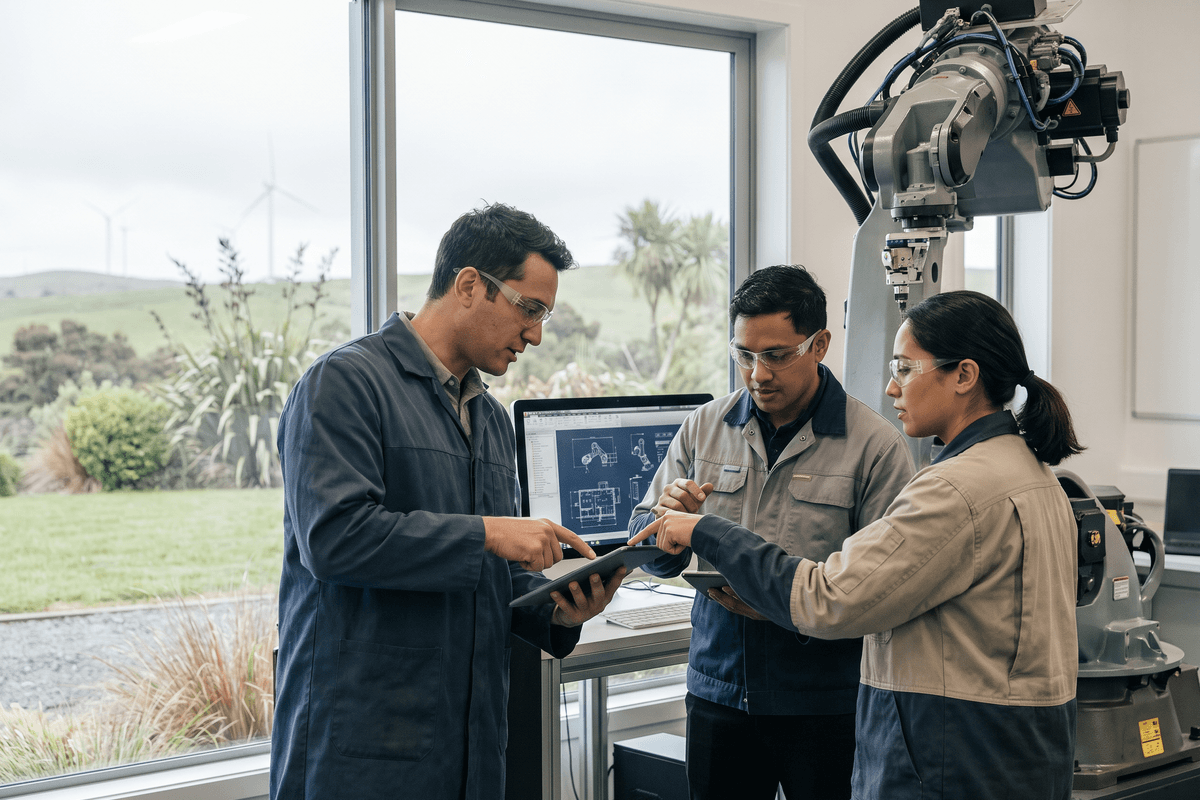



Across consulting offices, site sheds, and network operations centres from Auckland to Invercargill, artificial intelligence has quietly shifted from a speculative curiosity into daily workflows. Yet as computational speed accelerates, New Zealand’s engineering profession faces a profound reckoning. The true test of modern engineering is no longer how rapidly a model can be generated or how quickly code can be drafted, but whether practitioners possess the discernment, ethical grounding, and technical mastery to verify every line of output.
In its latest practice guidance, Engineering New Zealand Te Ao Rangahau outlines crucial updates around artificial intelligence adoption, addressing both generative design applications and the operational realities of Industrial Control Systems (ICS). The clear verdict: technology must elevate professional judgment, not replace it.
The Velocity Trap: Distinguishing Speed from Competence
The commercial pressure on engineering firms to compress delivery timelines has never been higher. With national infrastructure budgets under scrutiny and local councils demanding faster turnaround on regional works, generative AI tools have been marketed as the ultimate efficiency silver bullet. However, confusing speed with capability poses existential risks to engineering integrity.
While Large Language Models (LLMs) and automated design scripts can synthesize geotechnical logs, draft seismic design narratives, or generate initial structural framing options in seconds, they operate on statistical probability rather than fundamental physics. They do not understand the seismic volatility of the Alpine Fault, the complex volcanic soils of the Central Plateau, or the microclimatic wind loads of the Cook Strait.
"The objective cannot simply be faster engineering. If an algorithm delivers a flawed structural model ten times faster, it hasn't created value—it has merely multiplied risk. The goal must always be fostering better engineers."
When engineers rely on generative tools without interrogating underlying assumptions, "automation bias" sets in. Practitioners can become passive reviewers rather than critical interrogators, accepting plausible-looking data that masks critical structural or environmental vulnerabilities.
Industrial Control Systems: The Convergence of AI and Physical Infrastructure
While generative AI captures public attention, the most sensitive frontier for New Zealand engineers lies in Operational Technology (OT) and Industrial Control Systems (ICS). From municipal water treatment plants and hydro generation assets to port logistics and rail signalling, AI is increasingly embedded directly into supervisory control and data acquisition (SCADA) networks.
Applying machine learning algorithms to predictive maintenance and automated load balancing offers tangible gains in asset efficiency. However, connecting autonomous decision-making algorithms to physical actuators introduces distinct cyber-physical vulnerabilities:
- Non-Deterministic Edge Behaviour: Unlike traditional rule-based logic in Programmable Logic Controllers (PLCs), advanced machine learning models can produce unexpected outputs when faced with edge-case sensor telemetry.
- Expanded Attack Surfaces: Introducing AI middleware to bridge IT analysis platforms with air-gapped or legacy OT networks creates pathways for malicious exploitation.
- Data Drift in Dynamic Environments: Climate-driven weather volatility can skew historical datasets, causing automated control algorithms to miscalculate stormwater release rates or grid surge protection.
For systems engineers and asset managers across New Zealand, the mandate is clear: deterministic failsafes and hardware-level interlocks must remain absolute, regardless of how intelligent the supervisory software appears.
Accountability, Producer Statements, and the Legal Baseline
Under the New Zealand regulatory environment—anchored by the Building Act 2004, the Chartered Professional Engineers (CPEng) Rules, and the Health and Safety at Work Act 2015—accountability is strictly non-delegable. An algorithm cannot hold professional indemnity insurance, nor can it be summoned before an Engineering New Zealand disciplinary tribunal.
When a Chartered Professional Engineer signs a Producer Statement (PS1 for Design, PS2 for Design Review, or PS4 for Construction Monitoring), they personally certify that the design complies with the New Zealand Building Code. Relying on an unverified AI-generated calculation sheet or automated finite element analysis model does not constitute reasonable grounds for compliance.
Practical AI Integration Matrix
To assist firms in navigating risk, the following framework categorises common tasks by required verification levels:
| Engineering Domain | AI Application | Primary Risk Factor | Human Governance Requirement |
|---|---|---|---|
| Structural / Seismic | Automated member sizing & load distribution | Hallucinated boundary conditions; non-compliance with NZS 1170.5 | Mandatory manual spot-checks and independent peer verification (PS2) |
| Water & Civil | Hydrological modelling & pipe network routing | Over-reliance on outdated rainfall intensity datasets | Senior engineer review against localized climate resilience benchmarks |
| Industrial Systems | Autonomous SCADA load shedding & chemical dosing | Sensor drift, cyber breach, sudden telemetry outliers | Hardware interlocks; hardwired analog overrides; isolated networks |
| Project Delivery | Specification drafting & contract administration | Inaccurate clause references; generic non-NZ standard inclusions | Detailed redline review against specific conditions of contract (NZS 3910) |
Building Firm-Wide AI Governance: Practical Protocols
Engineering consultancies and public infrastructure entities cannot afford an ad-hoc approach where individual team members experiment with consumer-tier AI tools in isolation. Robust corporate governance is required to protect client confidentiality, intellectual property, and public safety.
- Establish Clear Data Boundaries: Prohibit the input of proprietary client CAD files, geotechnical borehole data, or sensitive infrastructure schematics into public, unvetted cloud models. Ensure commercial enterprise agreements maintain strict data isolation.
- Formalise Verification Checklists: Require that any calculation, code snippet, or technical report section generated with AI assistance be explicitly watermarked and paired with a documented, human-conducted verification record.
- Reinvest Saved Time in Critical Thinking: If an automated tool saves four hours on routine drafting, that time must be redirected toward site inspections, constructability reviews, client collaboration, and cross-disciplinary coordination—not merely used to inflate project billing volume.
- Embed Continuous Professional Development (CPD): Ensure junior and intermediate engineers continue to master first-principles engineering so they retain the technical foundation necessary to identify subtle AI hallucinations.
Looking Forward: Safeguarding Public Trust
The ultimate currency of the engineering profession is public trust. New Zealanders trust that when they cross a bridge, turn on a tap, or enter a high-rise office building, those structures and systems have been scrutinized by competent human minds dedicated to public safety.
Artificial intelligence offers unprecedented analytical capabilities that can help New Zealand tackle seismic resilience, decarbonisation, and ageing infrastructure. But technology is merely a lever; the fulcrum remains professional ethics, rigorous skepticism, and unyielding human accountability. By embracing AI as a catalyst to become better engineers, Aotearoa’s engineering community can lead the world in delivering infrastructure that is innovative, robust, and safe.